

When the ERP Becomes the Payments Interface, Who Owns the Financial Relationship?
Why SAP, Tereina and Circle’s latest developments point towards a fundamental change in how financial services are delivered through software.

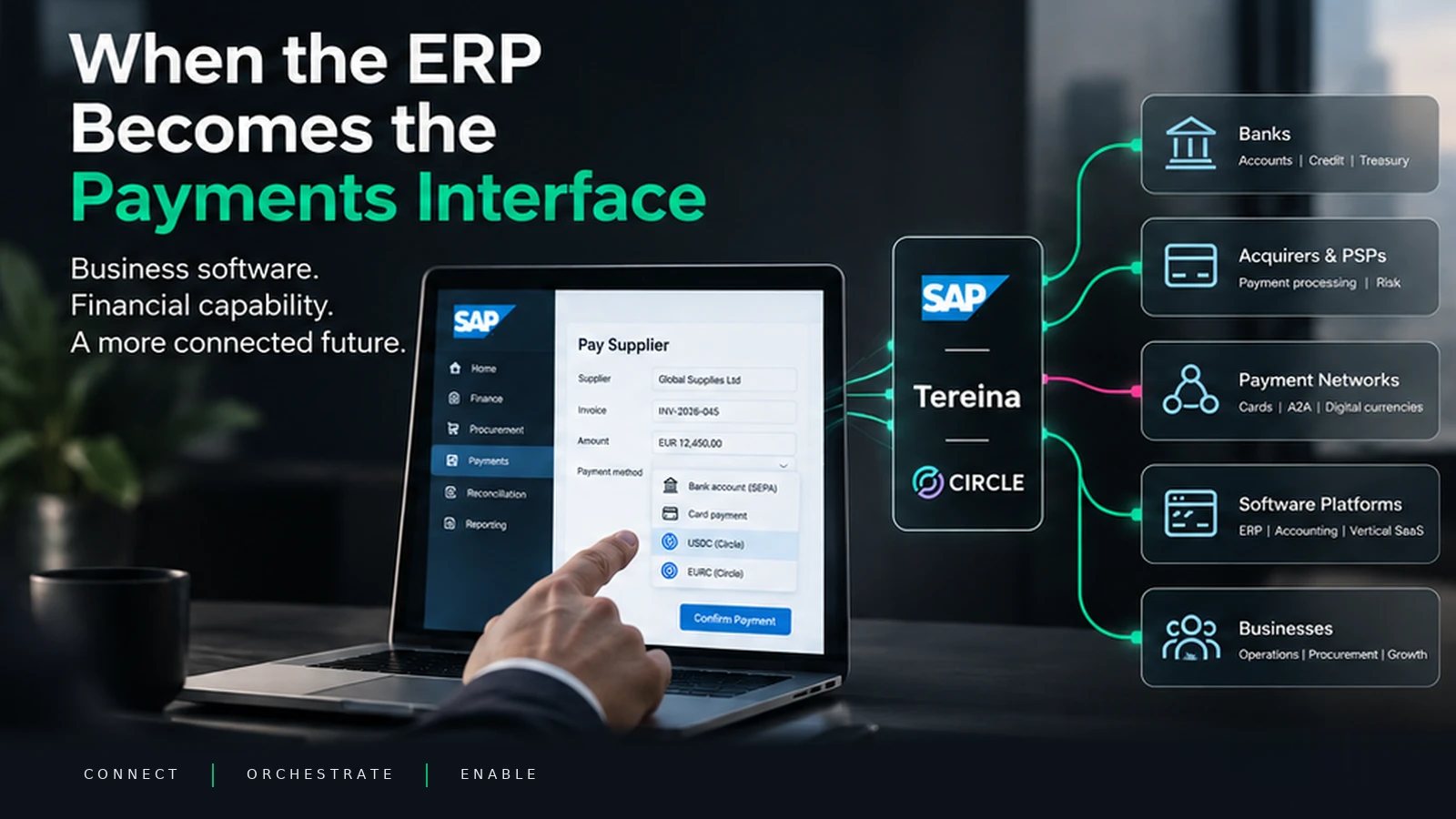
For decades, the relationship between businesses and their financial services providers has followed a relatively familiar model.
Banks provide accounts, credit and financial services. Acquirers and payment service providers facilitate transactions.
Software providers help businesses manage their operations.
Each operates within its own environment, with integrations connecting the various systems. But increasingly, that model is changing.
Businesses increasingly want their accounting, procurement, ERP or operational software to access financial services. They want those services available at the point they are needed, within the applications they already use.
The software is becoming the interface. Financial institutions are becoming embedded providers of capability and that has significant implications for the future of payments.
A useful signal from SAP, Tereina and Circle
Recent developments involving SAP-backed Tereina and Circle provide an interesting illustration of this direction.
Tereina’s embedded-payments proposition aims to bring payment execution and related financial processes directly into enterprise software environments, including SAP Cloud ERP.
Its announced partnership with Circle adds another potential dimension: the integration of digital-currency payment capabilities, including USDC and EURC, alongside more traditional payment infrastructure.
The Circle initiative remains at an early stage, with customer validation planned. It should not yet be interpreted as evidence of widespread enterprise stablecoin adoption. Nevertheless, the strategic direction is significant.
Consider the implications:
A business could increasingly manage procurement, approve invoices, initiate payments, reconcile transactions and access different settlement mechanisms without leaving its core operating software.
The customer interacts with the application.
Behind that application sit banks, payment providers, financial networks, settlement infrastructure and potentially digital currencies.
The complexity remains. But increasingly, it is managed behind the software experience rather than presented to the customer.
This is about more than introducing another payment method. It represents a change in where financial services are consumed and how they are distributed.
The changing role of software
Historically, many software platforms facilitated payments by integrating with a bank or payment provider. Payments were an additional feature, often provided through a separate commercial arrangement or technical integration.
Today, that relationship is becoming much more strategic.
Software platforms increasingly sit at the centre of a business’s daily operations. They understand the transactions being generated, the products being sold, the invoices being raised and the financial activity taking place.
This gives software providers something enormously valuable: context.
A bank may understand a customer’s financial position. An acquirer may understand its card transaction activity. But the software platform may understand why those transactions occur, how the business operates and what financial services it requires next. That creates opportunities extending well beyond payment acceptance.
Working capital, lending, treasury management, supplier payments, reconciliation and other financial products can potentially become integrated parts of the business workflow.
The opportunity is not simply to process the transaction. It is to provide the financial capability at precisely the point where the business needs it.
What does this mean for banks and acquirers?
There is a tendency to frame embedded finance as a competitive threat to traditional financial institutions. And yes, there are risks: As software platforms increasingly control the customer experience, banks and acquirers may become less visible to the businesses they serve. Distribution has shifted away from traditional direct-sales channels towards software ecosystems.
The financial institution risks becoming a supplier of underlying infrastructure rather than the owner of the customer relationship. But there is another way to interpret this development.
Banks and acquirers already possess many of the capabilities that software platforms need.
They have regulated infrastructure, payment networks, access to capital, financial products, risk-management expertise and established operational capabilities.
These are substantial value adds. The challenge is making those capabilities accessible within software environments, efficiently and at scale.
A bank does not necessarily need to build an ERP system. An acquirer does not need to develop software for every retail, hospitality or professional-services vertical. Instead, both need effective ways to connect their financial capabilities to the software platforms serving those markets.
That changes the strategic question from:
How do we bring more businesses directly to our financial services?
How do we make our financial services available wherever businesses already operate?
The distinction may sound subtle, but its implications for distribution, technology investment and commercial partnerships are considerable.
Connectivity becomes a strategic capability
There is, however, an important obstacle. Connecting financial institutions and software platforms is not always straightforward. Different APIs, integration standards, onboarding requirements, commercial models, risk processes and servicing arrangements create complexity.
A single integration may be manageable.
Building and maintaining relationships across dozens or hundreds of software providers is an entirely different challenge.
And the problem operates in both directions. Banks and acquirers need ways to onboard, manage and support software partners efficiently.
Software vendors need access to payment capabilities without having to rebuild integrations, operational processes and commercial relationships for every provider.
The result can be significant duplication of effort across the ecosystem. This is where the infrastructure connecting financial institutions and software platforms becomes strategically important.
The opportunity is to simplify the relationship between the two sides, enabling financial capabilities to be distributed through software without every participant having to recreate the same technology and operational processes.
Connectivity should not be the constraint that determines how quickly financial innovation reaches businesses. It should be the infrastructure that enables it.
The next layer: intelligence and orchestration
The emergence of AI adds another dimension. As financial services become more deeply integrated into business software, there is an opportunity to move beyond simply connecting systems.
Consider a software environment capable of identifying a cash-flow requirement, recommending a suitable financial product, initiating an approved payment or automating reconciliation.
These capabilities depend on access to reliable data, connected financial infrastructure and clearly defined permissions. They also require appropriate governance.
AI can assist with decision-making, identify opportunities and automate repetitive processes. But financial services involve regulatory obligations, commercial risk and accountability. Human oversight and clear controls remain essential.
The future may therefore involve a combination of four capabilities:
- 01
Connectivity
Enabling software platforms and financial institutions to work together.
- 02
Orchestration
Coordinating the processes, services and participants involved in delivering financial capabilities.
- 03
Intelligence
Using data and AI to improve decisions, automate workflows and identify opportunities.
- 04
Control
Appropriate and adequate oversight is required to ensure desired outcomes are met without increasing the risks of fraud, data misappropriation and of course regulatory compliance.
Together, these capabilities could fundamentally change how financial services are delivered through software. And they reinforce an important principle: the more seamless the customer experience becomes, the more sophisticated the infrastructure behind it may need to be.
From payment acceptance to financial enablement
At Path2AI, we believe this evolution has particular significance for banks, acquirers and independent software vendors. The payments industry has invested enormous effort in improving how transactions are accepted and processed. That remains important.
But the next stage of opportunity is broader. It involves enabling financial institutions to participate more effectively in the software ecosystems where businesses increasingly operate.
For banks and acquirers, this creates opportunities to develop new distribution channels, expand their relationships with ISVs and deliver more value through existing financial capabilities.
For software providers, it creates opportunities to embed financial services into their applications without having to become financial institutions themselves.
And for merchants, the ultimate benefit should be simpler access to the financial tools they need, delivered within the software they already use.
This is the direction in which we are building Path2AI: helping connect financial institutions and software businesses through a more scalable, intelligent operating layer.
The bigger picture
The SAP, Tereina and Circle developments are one example of a wider transformation.
The important story is not whether businesses ultimately settle a particular transaction through cards, account-to-account payments, stablecoins or another mechanism.
Those choices will continue to evolve.
The more fundamental shift is that the business may no longer need to interact directly with the financial infrastructure delivering the service.
Its software becomes the interface. Financial institutions provide the underlying capabilities. And the technology connecting the two becomes increasingly important.
For banks, acquirers and software providers, the strategic opportunity is not simply to participate in more transactions. It is to become part of the business workflows in which those transactions originate.
The future of payments may be less about where a business goes to pay, and more about how financial services come to the business.
Connecting financial institutions, software platforms and the businesses they serve.